
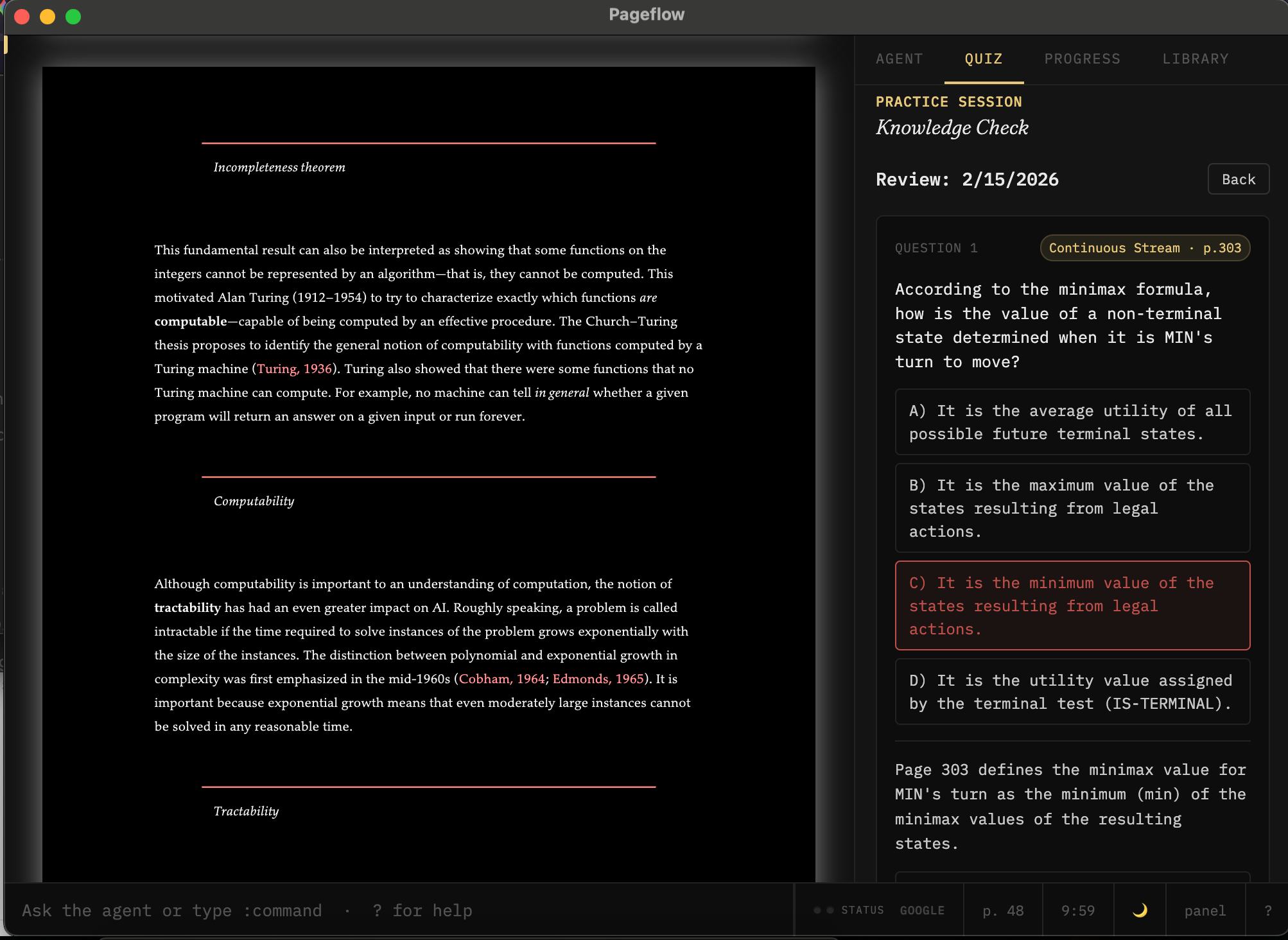
Highlighting feels productive because it leaves evidence of attention. A quiz feels harder because it asks whether the idea can be produced without the sentence in view. That brief difficulty is exactly what makes retrieval informative.
The problem is usually not convincing readers that active recall helps. It is the machinery surrounding it: create a deck, edit cards, schedule reviews, maintain tags, and decide which material deserves the system.
Ask while the context is alive
Pageflow can turn a page or range into a short set of questions immediately after reading. The questions know their source, the reading position is preserved, and a mistake can take you back to the relevant passage.
A useful quiz should feel like punctuation in the reading session—not a new project.
Keep the check proportional
Not every page deserves a card. Not every definition deserves weeks of scheduled review. A few questions can reveal whether the central mechanism, comparison, or claim survived. If it did, continue. If it did not, revisit the exact source.
This also changes what progress means. Completion is not simply reaching page 40. It includes moments when the reader tested an explanation and discovered where confidence exceeded understanding.
Export remains an escape hatch
Some readers already have a serious spaced-repetition practice. Pageflow should let them export useful material. But the core experience should not require everyone to become a knowledge-management hobbyist before they can understand a paper.
The simplest loop is still the strongest: read a coherent range, close the gap between familiarity and recall, return to the source when needed, and move on.